



Connection technology for gas systems
In the field of gas technology, manufacturers of complete gas systems are faced with the crucial question of the optimum connection technology for piping systems. While various methods such as flanges, press and clamp connections have their justification, brazing has been an established and preferred solution for decades for safety-critical applications with medium pressures and long-term requirements.
Basics of brazing
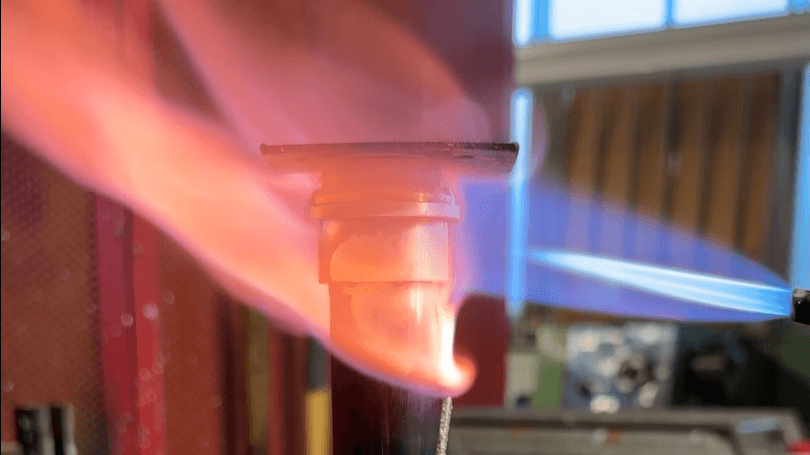
Brazing is a joining process in which two metal parts are permanently joined together by melting an additional filler metal – typically silver solder. The process takes place at temperatures above 450°C in an inert gas atmosphere to prevent scaling. This creates a metallurgical bond between the solder and the base materials, resulting in a homogeneous, extremely resilient joint.
This joining technique differs fundamentally from mechanical joining methods due to the molecular fusion of the materials involved. The brazing alloy completely penetrates the joint and creates a single, structurally uniform connection between the metal components.
Normative principles and technical requirements
The Technical Rules for Gas Installations (TRGI) define strict standards for gas installations, particularly with regard to the tightness of connections. According to TRGS 722 point 4.5 ff, gas installations for explosive hazardous substances must be “permanently technically tight”. Brazed connections meet this requirement due to their metallurgical fusion at molecular level.
The DIN 8505 standard specifies the technical requirements for brazing and guarantees uniform quality standards. Shear strengths of up to 100 N/mm² and tensile strengths of up to 200 N/mm² can be achieved, which corresponds to a theoretical compressive strength of 2,000 bar.
Particularly relevant is the restriction of alternative connection methods according to TRGS 722 4.5.2. point 8: Flanges with a smooth sealing strip are only to be regarded as “permanently technically tight” up to PN 25 bar and cutting and clamping ring connections only up to DN32.
Comparison of connection technologies
Brazing
The advantages of brazed connections are particularly evident in demanding operating conditions and after transportation from the manufacturer to the user:
Structural integrity: The homogeneous joint ensures even load distribution and minimizes weak points. The metallurgical fusion creates a joint that is mechanically identical to the base material.
High-pressure suitability: Brazing shows its superiority at pressures above 10 bar. The connections retain their integrity even under medium-high pressure loads and meet the safety requirements of critical applications.
Transport and long-term stability: Brazed connections are particularly resistant to vibrations during transportation and temperature fluctuations during operation. Therefore, brazed connections are still “technically tight in the long term” even after being transported halfway around the world. Of course, a detailed tightness test is mandatory before commissioning, but experience shows that brazed connections also withstand vibrations during transportation. These properties are crucial for the reliability of gas systems over long periods of operation.
Press and clamp connections
These connection techniques undoubtedly offer advantages during installation:
Installation speed: Press and clamp connections enable fast, clean installation without open flames, which is advantageous in certain environments.
Dismantlability: Clamp connections can be released if necessary, making maintenance work easier.
Limited applicability:With compression connections, the pipe end is pressed against a sealing ring by a union nut. Press connections irreversibly deform the pipe and fitting together.
Both methods show limitations at high pressures and long-term stress.
Press and clamp connections can leak under mechanical loads, vibrations or improper installation. Correct installation is critical – installation errors can lead to leaks, which manifest themselves particularly under high pressure loads.
Copper as a material for gas applications
The choice of material plays a decisive role in the longevity of gas technology systems. Copper and its alloys offer outstanding properties for gas-conducting systems.
Normative approval
The use of copper for gas-carrying pipes and fittings is permitted and established in accordance with EN 1057 and DVGW Code of Practice GW 392.
Hydrogen resistance
Studies carried out by the Gütegemeinschaft Kupferrohr with the Ruhr University Bochum show that precipitation-hardening copper alloys can achieve strengths that are comparable to high-strength steels, but show practically no embrittlement effects when exposed to hydrogen. This property makes copper particularly attractive for modern hydrogen applications.
Corrosion resistance and conductivity
Copper alloys have high corrosion resistance and excellent thermal and electrical conductivity. These properties are advantageous for many gas technology applications.
Medical gas applications
Seamless copper pipes in accordance with DIN EN 13348 are preferred for medical gas supplies. These transport oxygen and other medical gases from the technical room to the patient’s bed. The antimicrobial surface properties of copper can effectively kill bacteria, fungi and viruses, which is particularly relevant for medical applications.
Quality assurance and certification
The quality of brazed joints depends to a large extent on the competence of the skilled workers carrying out the work. The DIN EN ISO 13585 912 standard defines the requirements for the qualification of brazers and ensures that the necessary skills are demonstrated through regular testing.
Inspection certificates are an essential part of complete documentation and guarantee the traceability of quality. Continuous training of specialists is necessary to keep pace with evolving technical standards.
Economic efficiency
Although the initial installation of brazed connections can be more complex than with alternative methods, the economic benefits become apparent in the long term:
Low maintenance: The high reliability of brazed connections significantly reduces maintenance intervals and unplanned downtime.
Longevity: Structural integrity over decades minimizes replacement investments and reduces total cost of ownership.
Safety: Reliable tightness prevents costly leaks and the associated safety risks.
Conclusion
For plant engineers and installers in gas technology, brazing copper pipes is the optimum connection technology for safety-critical applications. The combination of normative conformity, technical superiority at high pressures and long-term reliability makes this technology the first choice for demanding gas technology installations.
Metallurgical fusion creates connections that are “technically tight in the long term” and meet the strict requirements of TRGI and TRGS. In combination with the outstanding properties of copper materials – in particular hydrogen resistance and corrosion resistance – a system solution is created that meets the highest safety standards.
Investing in qualified specialists and their continuous further training in accordance with DIN EN ISO 13585 912 is a decisive success factor for realizing the technical advantages of brazing in practice.